10 Free Brain Games for Adults and Seniors
The best free brain game is one you enjoy enough to play again. Start with memory pairs for recall, word games for language, or a counting-and-strategy game for planning. You do not need a paid subscription to make a pleasant, mentally engaging routine.
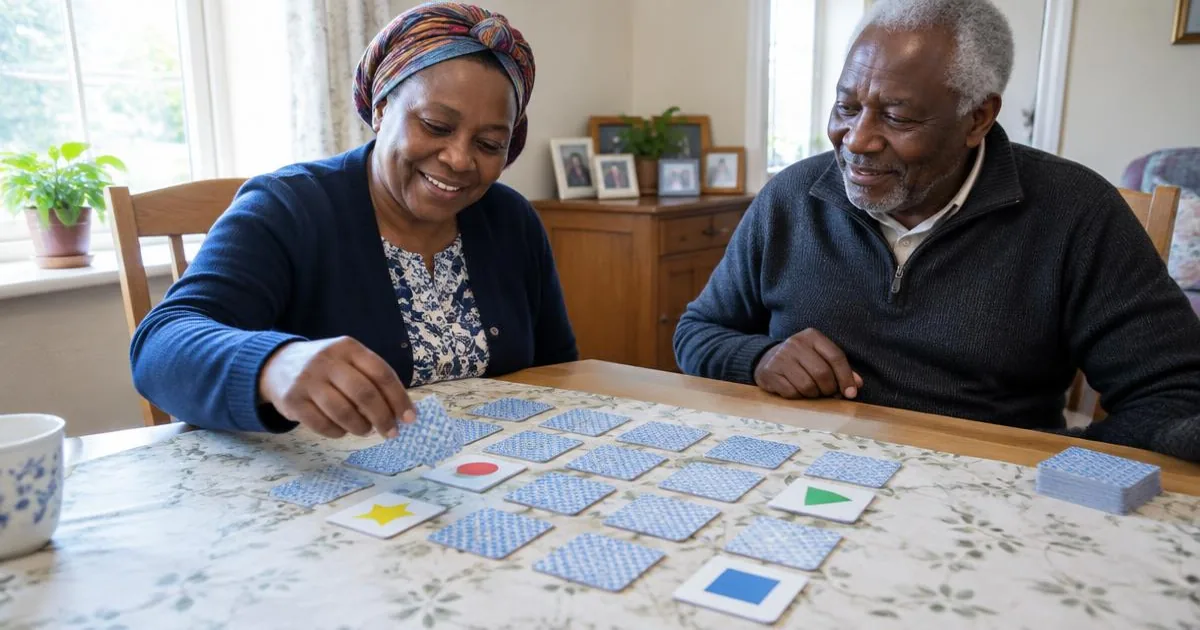
This guide offers ten practical choices for adults and seniors, including games you can make with paper and ordinary household materials. “Brain game” here describes a mentally engaging activity, not a treatment or a promise to prevent dementia. The featured image is AI-generated, not a photograph of a study or clinical session.
What can brain games actually do?
Practising a game can make you better at that game. Whether that improvement transfers to everyday memory or protects against cognitive decline is a different question. The WHO evidence review discusses cognitive training and stimulation, with limitations in the evidence; it does not establish that any particular recreational app prevents dementia.
A research-based overview in The Conversation also distinguishes task practice from broad claims about intelligence and brain health. Treat entertainment as entertainment, and seek professional advice for new or worsening memory difficulties.
Ten free brain games to try
1. Homemade memory pairs
Draw six pairs of matching symbols on twelve identical pieces of card. Shuffle them face down in a grid. Turn over two cards; keep a matching pair, or turn both back before the next turn. Begin with four pairs if twelve cards feel crowded. Large, high-contrast shapes are easier to distinguish than tiny pictures.
2. Category chain
Choose a category such as foods or animals. Take turns naming one item without repeating an earlier answer. For an extra challenge, each person repeats the last two items before adding their own. Keep it untimed and allow a pass so the game remains sociable rather than a public memory test.
3. A homemade word search
One player hides five agreed words in a square grid of letters; another finds them. Start with horizontal words only, then add vertical or diagonal ones if desired. Use large lettering and a ruler or paper strip to help someone follow a row. Swap roles so creating the puzzle is part of the game.
4. Make ten with cards
Remove picture cards and use ace as one. Deal five cards face up and look for two or more that total ten. Set a successful group aside and replace it. If nothing works, replace one card. This is our informal house game, so decide whether one card showing ten counts before beginning.
5. Spot the change
Place five familiar objects on a tray and let everyone look. Cover the tray while one object is removed or moved, then uncover it. Players say what changed. Increase the number of objects only when the current version is enjoyable; naming the objects aloud first is a useful adaptation.
6. Paper noughts and crosses
Draw a three-by-three grid and alternate marking X or O in empty squares. Three in a row wins; a full grid without a line is a draw. Ask what would happen if a player chose another square. Discussing possibilities can be more interesting than rushing through repeated games.
7. A counting path game
Draw a track of twenty spaces, choose counters and roll a die to move. Agree that a roll beyond the final square ends the race, avoiding a long wait for an exact finish. Ask how many spaces remain before each turn. For a richer version, use two dice and choose addition or subtraction. Our screen-free maths guide has more counting ideas.
8. Mancala with a homemade board
An egg carton and two bowls can become a casual Kalah board for players comfortable handling small counters. Sowing counters one at a time makes the next move visible. Follow our Mancala rules guide rather than mixing Kalah rules with Oware. Use large safe counters and a shallow tray if small objects are difficult to grasp.
9. A shared story chain
One person begins with a sentence; the next adds another. Agree on a setting and stop after everyone has contributed twice. A cooperative story does not need scores or correction. Write down key characters if remembering the whole story makes participation harder.
10. A gentle toss-and-catch challenge
Use a soft beanbag or rolled pair of socks and practise a small seated toss into the same hand, keeping the motion within easy reach. Add a clap only if comfortable. Traditional Jacks and Knucklebones explore related timing patterns; they are not appropriate equipment or rules for every player. For a screen-based interpretation, discover NHODO, without assuming it provides the same physical practice.
Choose a game that fits the player
For lower vision: enlarge cards, use contrasting marks and reduce the number of objects on the table. Do not rely on colour alone to identify a pair.
For limited hand movement: ask a partner to move pieces, choose word games, or use a stable surface with larger counters. Offer seated play without reaching across the table.
For a mixed-ability group: play cooperatively, remove time limits and agree that passing is always allowed. A familiar game with one small variation can be more welcoming than several new rules at once.
Make it a pleasant routine, not a performance test
Pick one game, set it up somewhere comfortable and stop before frustration replaces enjoyment. Rotate between language, counting, visual observation and social play. There is no medically validated daily session length for the informal games in this list.
A notebook can record games you enjoyed or useful adaptations, rather than tracking a supposed “brain age”. If someone develops persistent memory problems, do not use their game score to diagnose them or postpone medical advice.
Frequently asked questions
These activities need no subscription. Most can be made with paper, cards or items you already own, although materials may cost money if you buy them.
This guide makes no such claim. Enjoyable mental activity is not proof that a specific game prevents dementia or treats memory loss.
Start with four pairs of large matching cards or an untimed category chain. Let the player choose which feels more enjoyable.
No. Untimed, cooperative versions are often easier to include in a mixed-ability group, and speed is not required for enjoyment.
No. They use different movements and controls. Choose based on interest and accessibility rather than assuming their effects are interchangeable.
New, worsening or everyday-life-disrupting memory difficulties deserve professional advice. A recreational game cannot diagnose their cause.
Find the version you want to repeat
Begin with one simple activity and adapt the materials, pace and rules together. For more cultural and family-play ideas, explore our traditional African games guide.
Sources and Further Reading
Game rules, names and terminology vary between communities and regions.