Mancala Rules: How to Play Kalah, Plus Oware Explained
Mancala rules depend on the version you are playing. For the common four-stone Kalah game, put four stones in each of twelve pits, take all the stones from one pit on your side, and sow them counterclockwise. Include your own store, skip your opponent’s store, and try to finish with more stones than your opponent.
This guide explains that version step by step, then separates it from Oware and other African sowing games. If you are looking for a throwing-and-catching stone game rather than a board game, start with our traditional African games guide or Jacks and Knucklebones guide.
What is Mancala?
Mancala is a family of games, not a single universal ruleset. Players usually lift counters from a pit and distribute them into other pits in a prescribed order, a movement often called sowing. Boards, directions, capture conditions and winning conditions differ between games.
The Penn Museum’s overview of Mancala describes games played across Africa, Asia and beyond, using seeds, stones and other counters. A board may be carved from wood or made by scooping hollows into the ground. Avoid assuming that every two-row board uses the same rules.
Kalah is the version many commercial sets in the United States call “mancala”. It belongs to this wider family, but is a modern commercial game rather than a name for every traditional African variant. The Penn Museum’s account of the Mancala collection explains that distinction.
Mancala setup: the four-stone Kalah version
Players: Two.
Equipment: A board with two rows of six small pits, one larger store at each end, and 48 stones or seeds.
Starting position: Four stones in every small pit; both stores empty.
Goal: Finish with more stones in your store.
Sit opposite each other with the board between you. You control the six small pits nearest you and the large store on your right. Stone colours do not belong to individual players: you choose moves from your side, regardless of the colours in a pit.
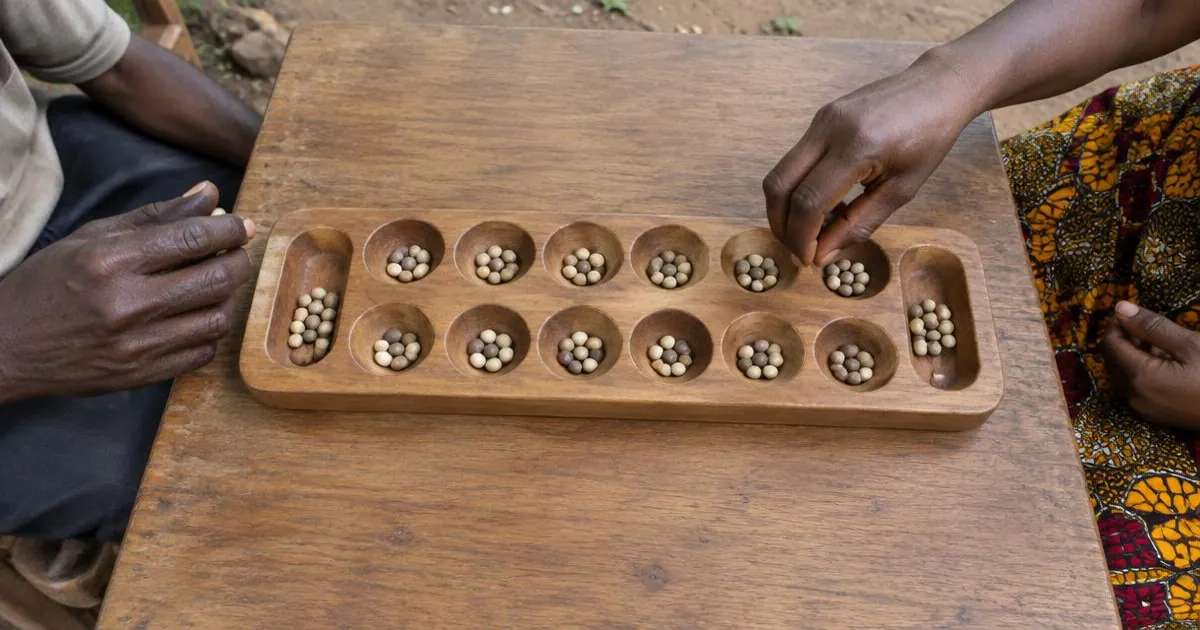
The illustration is AI-generated and shows equipment during play, not an exact starting arrangement. For a fresh game, count four stones into every small pit yourself. These instructions use the four-stone setup described in the Washington education department’s Mancala rules. Sets using six stones per pit have different starting totals.
How to play Mancala, step by step
1. Choose a pit on your own side
Choose who starts, then take all the stones from any non-empty small pit in your row. You cannot choose your opponent’s pit or pick stones back out of a store. The pit you lift from becomes empty.
2. Sow the stones counterclockwise
Starting with the next pit, drop one stone into each successive pit. Move counterclockwise around the board. Put a stone into your own store when you reach it, but always skip your opponent’s store. Continue onto the opponent’s row if you still have stones left.
For a simple first move, choose the pit four spaces before your store: four stones finish in the store, earning another turn. Count the landing spaces before you lift anything. The first stone goes into the next pit, not back into the pit you selected.
3. Take an extra turn when you finish in your store
If your last stone lands in your own store, take another turn immediately. Choose another non-empty pit on your side and sow again. You can earn successive extra turns, but the game still ends as soon as one entire row becomes empty.
4. Capture across from an empty pit
In the version used here, if your final stone lands in a previously empty pit on your own side and the opposite pit contains stones, move your final stone and all stones directly opposite into your store. You do not capture simply because you pass an empty pit, or because you finish on your opponent’s side.
For example, if your last stone lands in your empty pit opposite five stones, you collect six stones: the five opposite plus your final stone. The opposite-pit condition is set out in the Rose-Hulman Kalah rules, which use a different six-stone starting setup. Agree any house-rule differences before playing.
5. End the game and count the stores
The game ends when all six pits on either player’s side are empty. The player whose row still contains stones moves those remaining stones into their own store. Count both stores: the higher total wins. With 48 stones, a 24–24 finish is a draw.
Do not leave the remaining stones out of the final count. They belong to the player whose side they are on, not automatically to the player who made the last move.
Beginner Mancala strategy
Count your final landing space. Before every move, work out where the last stone will land. That space determines whether you gain an extra turn, capture, or hand play back to your opponent.
Check both sides for captures. An empty pit on your side can become a capture opportunity, but a large pile opposite an empty enemy pit may be vulnerable. Look at what your opponent can do next, not only what you can collect now.
Consider the endgame. Emptying your row is not automatically a winning move. Count what your opponent will collect from their remaining pits before deliberately ending play. A tempting bonus turn may be less useful than a move that protects a larger capture.
These are practical starting habits, not a guaranteed winning formula. The useful exercise is to explain your count aloud, then compare your predicted landing pit with the actual move.
Mancala vs Oware: why the rules are different
Oware is another two-row, six-pit game associated with West Africa and the Caribbean. In the version described by Masters Traditional Games, play starts with four seeds per pit, but the capture rules are not Kalah’s empty-pit capture rules.
Oware captures can occur when the last seed leaves an opponent’s pit holding two or three seeds, with possible captures working backwards through qualifying opponent pits. Feeding and starvation rules also matter: a player may need to make a move that gives the opponent seeds to play. Endgame situations need the full Oware rules, not a shortcut borrowed from Kalah.
Kalah’s store-based bonus turns should not be imported into Oware. Bao and other Mancala-family games introduce still more differences. Our African games overview puts Oware alongside other traditions without treating them as interchangeable.
Is Nhodo a Mancala game?
No. Nhodo is a Zimbabwean throwing-and-catching pebble game, not a pit-and-sowing board game. The use of stones is a material similarity, not evidence that the games share the same rules.
In NHODO, you toss Amai, move the smaller pebbles and time the catch. If that sounds closer to the game you remember, read how to play Nhodo. For another toss-and-pick-up comparison, see how to play Jacks and Knucklebones.
Frequently asked questions
This four-stone Kalah setup uses 48 stones: four in each of twelve pits. Other variants use different totals, so follow the rules for the version you choose.
Not in the Kalah version explained here. Sow through the small pits on both sides, include your own store and skip your opponent’s store.
You get another turn when the final stone of your move lands in your own store, unless the board has reached the end-of-game condition.
In this Kalah ruleset, an empty-pit capture starts when your last stone lands in a previously empty pit on your own side, opposite a non-empty opponent pit. Oware uses different capture rules.
No. Mancala names a family of sowing games; Oware is one member of that family. Kalah is another, with different capture and extra-turn rules.
Yes. Arrange twelve small cups in two rows, with a larger container at each end as a store. Use suitable counters and keep small pieces away from children who might swallow them.
Your first game
Set out twelve pits, count four stones into each, and agree the capture rule before you begin. During the first few moves, count aloud and check the final landing pit together. Once the sequence feels familiar, focus on predicting the reply rather than simply picking the fullest pit.
Sources and Further Reading
Game rules, names and terminology vary between communities and regions.
- Washington Office of Superintendent of Public Instruction — Mancala rules (four-stone version)
- Rose-Hulman — Kalah rules (six-stone setup; opposite-pit capture condition)
- Penn Museum — Mancala: Games That Count
- Penn Museum — Sowing the Seeds of Competitive Play
- Masters Traditional Games — Oware and Bao rules