How to Play Jacks: Rules, Knucklebones and the Nhodo Connection
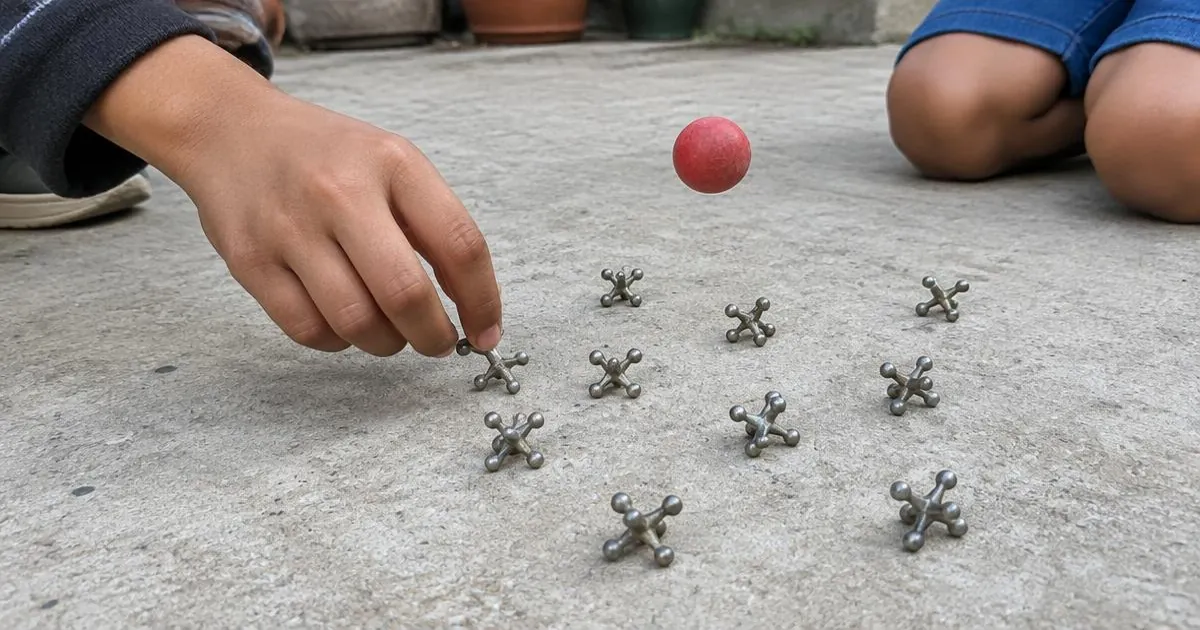
To play a common one-bounce version of Jacks, scatter ten jacks, toss a small ball, pick up the required number of pieces with the throwing hand, and catch the ball after its first bounce but before its second. Start by collecting one jack per throw, then progress to groups of two, three and more.
There are many versions of Jacks and Knucklebones. This guide teaches a friendly ten-piece version, explains the differences, and compares the shared toss-and-pick-up action with Zimbabwe’s Nhodo. For the wider context, explore our traditional African games guide.
What are Jacks and Knucklebones?
Jacks is a dexterity game built around a short window of time: something is tossed, pieces are picked up, and the tossed object must be caught. Modern sets often contain small metal jacks and a rubber ball, but related games use stones, seeds, small bags or bones.
Museums Victoria’s account of Jacks documents this variety and describes the common throwing, picking-up and catching pattern. Its collections also show that the word “jacks” does not always mean the same equipment or sequence.
Knucklebones refers to games historically played with small animal bones, and is also used as a name for some modern pick-up games. Do not assume every game called Knucklebones uses a bouncing ball: some use one of the pieces itself as the throwing object. The Strong National Museum of Play’s Jacks entry places these games in a broad international tradition.
What you need to play Jacks
Equipment: Ten jacks and one small rubber ball for the version below.
Players: One for practice, or two or more taking turns.
Surface: A clean, flat area where the ball can bounce predictably.
Goal: Complete the agreed sequence of pick-ups with the fewest mistakes.
Choose a ball small enough to catch comfortably and test its bounce before starting. Scatter the jacks loosely within easy reach. They should not be piled together, but they should not require an unsafe stretch either. Keep your non-playing hand out of the collection area.
The featured picture is an AI-generated illustration of the equipment, not a historical photograph. Metal jacks have projecting points and small pieces can be choking hazards, so use age-appropriate equipment and supervision. Do not play near traffic or where a missed ball could roll into danger.
How to play Jacks: a friendly one-bounce version
The sequence below is one agreed house ruleset, not a claim that all communities play identically. Before starting, decide whether touching an uncollected piece is a foul and where a player resumes after a missed turn. Here, touching an extra piece ends the turn, and a player retries the incomplete stage on their next turn.
1. Scatter the pieces and toss the ball
Scatter ten jacks on the surface. With your playing hand, toss the ball gently upwards. A controlled toss is more useful than a very high throw: you want enough time to pick up the pieces while keeping the ball within a comfortable catching area.
2. Collect one jack and catch after one bounce
While the ball is in the air, pick up one jack with the same hand that threw the ball. Let the ball bounce once, then catch it before it bounces again. Keep the jack in your hand as you catch.
Put the collected jack aside and repeat with the remaining pieces. This stage is commonly called onesies. Each successful throw removes one piece from the playing area, until all ten have been collected.
3. Move on to twosies and larger groups
Scatter all ten again. For twosies, pick up two jacks on each throw, then catch the ball after one bounce. Five successful throws clear the ten pieces. For threesies, collect three, three, three and then the remaining one.
For a clear sequence with ten pieces, use these groups:
Ones: ten groups of one.
Twos: five groups of two.
Threes: three groups of three, then one.
Fours: two groups of four, then two.
Fives: two groups of five.
Sixes to tens: collect the named number first, then any remainder on the following throw.
Always agree the remainder order in advance. Some players collect the smaller remainder first or use other sequences. Neither choice needs to be treated as the one universal rule.
4. Pass the turn after a mistake
In this friendly version, your turn ends if you fail to catch the ball, let it bounce twice, collect the wrong number of jacks, or touch a piece you are not collecting. Leave the completed stages recorded mentally or on paper, then pass play to the next player.
On your next turn, scatter all ten and restart the incomplete stage. If you were partway through twosies, you retry twosies, not the entire game. For solo practice, simply repeat that stage until you can clear it comfortably.
5. Agree how the game ends
For a short game, the first player to finish fivesies wins. For a longer challenge, continue through tensies. Giving everyone the same number of turns makes a friendly competition fairer when one player goes first; tied finishers can share the win or play another agreed stage.
Jacks rules that vary between groups
Some groups catch the ball without a bounce. Others allow additional bounces, use five rather than ten pieces, change the collection order, or add actions such as clapping. Games using stones or small bags may throw one piece and catch it directly rather than use a separate ball.
Those differences matter because they change the available collection time. Before introducing a new player, demonstrate a complete turn rather than relying on the game’s name. Museums Victoria is useful further reading precisely because it records a range of materials and methods, not just one retail set.
Tips for learning the Jacks game
Practise the toss and catch first. Make several gentle one-bounce catches without collecting anything. A predictable ball path gives you a repeatable window for the pick-up.
Choose the pieces before throwing. Identify the next group while the ball is still in your hand. Looking for a target after the toss wastes time and encourages a rushed reach.
Start with a shorter stage. Five pieces can be enough to practise ones and twos. Increase the number when the movement feels controlled rather than chasing a fast completion time immediately.
Reset an awkward scatter. For beginners, agree a reachable playing area and allow a new scatter before the stage starts if pieces land outside it. Once a throw begins, keep the agreed rules consistent.
These are practice suggestions, not medical claims about development. Jacks uses hand-eye coordination, but this article does not claim that it treats a condition or is better than another activity.
Jacks, Knucklebones and Nhodo: what connects them?
Their shared idea is easy to recognise: toss an object, do something with smaller pieces, then catch the object before the opportunity disappears. That resemblance makes Jacks a useful comparison when explaining Nhodo, but it does not make their names or full rules interchangeable.
In the Zimbabwean game described in our Nhodo overview, players use a larger throwing pebble and smaller stones. In the NHODO game, Amai is the throwing pebble, with timed catches and smaller pebbles moved around a circle. Read how to play NHODO for the app’s own sequence rather than applying the bouncing-ball rules above.
Stone-based equipment can also appear in very different games. Mancala and Oware are sowing board games involving counts and captures, not catching a thrown object. The material alone does not identify the game.
Frequently asked questions
The friendly version in this guide uses ten. Five-piece versions and other local sequences also exist, so agree the number before starting.
In the version taught here, it bounces once before you catch it. Other variants use no bounce or different throwing pieces.
Yes, in this ruleset. Toss the ball, pick up the pieces and catch the ball with the same playing hand.
Collect groups of the required size, then the remainder on a separate throw. For threesies here, that means three, three, three and one. Agree any different remainder order beforehand.
The names overlap in some places, but equipment and rules vary. Historical knucklebones games and modern metal-jacks games should not all be treated as one identical ruleset.
They share a toss-and-pick-up idea, but Nhodo has its own Zimbabwean context and play variations. NHODO’s app rules are also distinct from the one-bounce Jacks version in this guide.
Start with one good catch
Choose a flat surface, agree the bounce rule, and practise a gentle toss. Then add one pick-up at a time. When you can clear onesies reliably, try pairs and compare how much planning each throw needs. To explore another take on the same timing challenge, discover NHODO.
Sources and Further Reading
Game rules, names and terminology vary between communities and regions.