8 Screen-Free Math and Strategy Games for Kids
Screen-free maths games make quantities visible: children can count counters, compare groups and explain a move using real objects. Start with a small set and a simple turn, then change one rule when the current version feels comfortable.
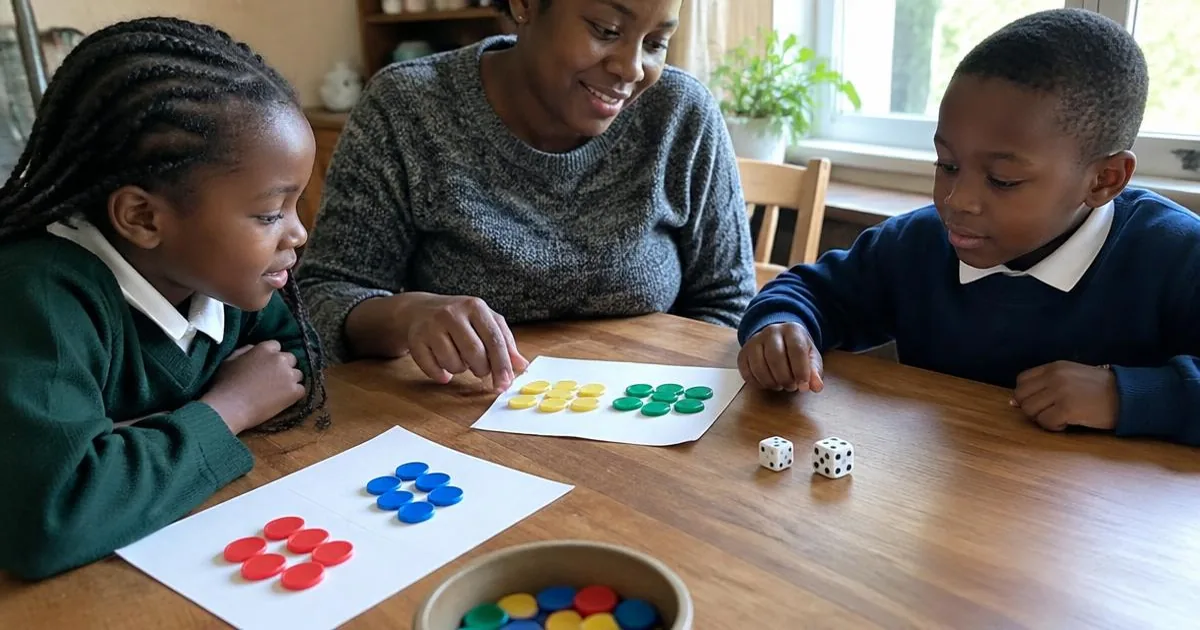
These eight games use paper, dice, cards or safe counters. They are practical learning opportunities, not a promise of higher test scores or a replacement for teaching. The featured image is an AI-generated illustration of family play.
What to practise before adding harder rules
Saying number words and counting a collection are not quite the same task. Encourage the player to touch or move each object once, then say how many there are altogether. The Erikson Institute's counting overview explains why counting involves more than reciting a sequence.
Keep materials age-appropriate. Dice, stones and counters can be choking hazards; use larger suitable pieces and active supervision. Choose a stable table, clear the floor of loose pieces and avoid speed rules that encourage throwing objects.
Eight screen-free maths and strategy games
1. Race to ten
Draw a track of ten spaces for each player. Roll a die, take that many counters and fill the next empty spaces. In this house version, a roll that would go past ten fills the remaining spaces and finishes the race. Say the starting total, the new counters and the final total aloud.
Easier: Use a die marked only one to three or let a partner help count. Harder: Ask how many spaces remain before rolling. The Erikson Institute's Race to Ten example connects small sets with counting and number sense; our finish rule is simply a family-friendly choice.
2. Which group has more?
Make cards with dot groups from one to six. Shuffle and deal them between two players. Turn over one card each; the larger quantity takes both. For a tie, each player keeps their own card. Play until the deck is used, then count collected cards together.
Easier: Put actual counters beside each card to compare. Harder: Use different dot arrangements so the picture's shape does not always reveal the quantity. Erikson's discussion of number arrangements gives useful context for comparing visible groups rather than relying only on numeral recognition.
3. Make ten
Use number cards from one to ten, with picture cards removed. Deal five face up. On a turn, select two cards that total ten, collect them and replace them. If no pair is possible, swap one card from the deck. In this version a single ten does not count; agree changes before playing.
Easier: Build each number with counters and physically join the groups. Harder: Allow three-card totals. Ask “How do you know?” without demanding an instant answer.
4. Roll, build and compare
Each player rolls a die and builds a group with that many counters. Compare which has more and how many more it has. Play cooperatively: the aim is to agree on the comparison, not collect a prize for the largest roll.
Easier: Line the groups up side by side for one-to-one matching. Harder: Roll two dice per player and compare their sums. Encourage an explanation such as “These five match, and there are two left over.”
5. Pattern detective
Build a repeating pattern with large blocks or drawn shapes: circle, square, circle, square. Another player adds the next two items and explains the repeat. Swap roles, then hide one item inside the pattern and ask what is missing.
Easier: Use a short two-item repeat. Harder: Try a three-item unit or ask whether two differently coloured patterns have the same repeating structure. A pattern need not depend on colour; shape or texture can make it more accessible.
6. Build a number path
Draw twenty numbered spaces and take turns rolling a die to move a counter. Here, reaching or passing twenty finishes the game. Before moving, ask where the counter will land; afterwards check by counting the steps. Remember that the starting square is not the first step.
Easier: Use a shorter path. Harder: Roll two dice and choose their sum or the larger minus the smaller. The Erikson Institute's path-game guide describes questions about remaining distance and number relationships.
7. Take one or two
Place nine large counters in a row. Two players alternate taking one or two. In this house version, the player who takes the last counter wins. Play a few rounds, then discuss whether leaving a particular quantity changes the next player's options.
Easier: Start with five counters and talk through each choice. Harder: Try a different starting total or reverse the winning condition. Change only one rule at once; this is a small planning game, not a universal traditional ruleset.
8. Mancala counting and planning
Players who are ready for a longer ruleset can try four-stone Kalah with two rows of six pits and end stores. Sowing counters one at a time makes counting and turn planning visible. Read our full Mancala rules guide for extra turns, captures and the end of the game rather than relying on this short description.
Easier: Practise sowing one handful around an empty board without scoring. Harder: Predict the final pit before moving. Kalah and Oware have different rules, so do not casually mix them.
Ask questions that reveal the thinking
Try “How many altogether?”, “How many more do you need?” and “Could you show that another way?” Wait for a response and accept counters, drawings or spoken explanations. A player who needs to count each object is still participating meaningfully.
If a game becomes confusing, lower the quantities or remove a rule. Do not assume that struggling with one dice game reveals a learning disorder. Persistent concerns about learning deserve discussion with an appropriate teacher or professional.
Where traditional play and NHODO fit
Traditional African games include many different challenges, from strategy to timing. Their cultural context matters: not every game using stones is Mancala, and not every catching game has identical rules.
NHODO is a digital stone-catching interpretation. It can be enjoyed alongside hands-on play, but it is not screen-free and this guide does not claim it teaches the same skills as manipulating counters. For a separate physical-activity list, explore our fine motor games.
Frequently asked questions
Compare two small groups of counters, or use a short race-to-ten track. Pick quantities the player can handle comfortably.
No. Many of these games can use homemade paper cards and safe objects you already have. Materials may cost money if purchased.
No. Counting, moving objects and drawing are valid ways to explain an answer. Increase mental demands only when appropriate.
Small loose pieces can be choking hazards. Use age-appropriate larger alternatives and active supervision.
No. It is a family of sowing games. The linked guide teaches Kalah and separately explains Oware differences.
No. NHODO uses a phone or browser. The tabletop activities in this article are the screen-free options.
Make the next move understandable
Start small, make the quantities visible and let players explain a choice. The useful conversation often happens between turns, not when someone wins the race.
Sources and Further Reading
Game rules, names and terminology vary between communities and regions.